Saturday, June 4, 2011

Veneta Donaldson: A Poet in the Family


Veneta Donaldson, early 1930s

This is my aunt--my mother's much-older sister, who lived from 1909 to 1996. She was a single working-girl in Texas from the late 1920's through the 1940's. Marrying at age 40, she continued with her secretarial career until retirement. Much like Emily Dickinson, she wrote poetry that was almost never seen by anyone. She typed the early ones and hand-wrote the later poems--most of them were on nice stationery paper. The first set was bound with a ribbon. Her poetry ranged from deeply philosophical to sentimental to whimsical: all intelligent and masterful in style.

I will be posting some of my favorites here, and I hope you enjoy them as much as I did.


Patterns
by Veneta Donaldson

Man's life is but a pattern here
That molds his own infinity
Beyond his laughter and his tear,
Deception and veracity.

Sometimes the pattern's mutable
And precious gain is lost to him;
Often opaque, insensible,
And all the hours are aimless, dim.

Perhaps but once within his soul
His life is clear as God's own star;
He sees ahead the final goal
And knows why mortal patterns are.

The following poems by Veneta Donaldson are included in this series:

- Patterns
- Akin to Prayer
- Tornado Town
- An Aquarelle
- His Mother's Prayer
- Reiteration
- Beauty
- Surely They Remember
- To N.J.D. and P.C. McC.
- I Saw Her Standing There
- I Often Wonder
- The Clock
- The Answer
- Old Houses
- Summer's Child
- Haven
- Within the Night
- The Darkened Hours
- They Told Me —
- In Memoriam
- Impasse
- Moment Exquisite
- Little Old Lady in Blue
- And Now I Keep My Promise


Additional poetry by Veneta Donaldson
- Picture of Autumn
- Time of Yule
- Faith Absolute
- God's Artistry
- The Language of Autumn
- Snow Flakes
- Glimpse of Spring
- I Watched a Star

Wednesday, June 1, 2011

Evolution of a Rug


Check out my grandmother's hand-hewn crochet hook, upper left.

It's Work-In-Progress Wednesday, and I'm back! In December, we bought a new house in a new town, and I have been up to my eyeballs in boxes, packing materials, and stuff. For the last few months, my time has been mostly spent unpacking and selling-off zillions of items from three households (mine, my husband's, and a friend who passed away).

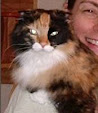
We have a very old cat--adopted him from our departed friend. He is becoming incontinent, and he usually makes it to the vicinity of the catbox, but... well... let's just say the floor of the utility room is getting cleaned A LOT. I put my little t-shirt yarn rug there, and it's working well because it's so easy to wash. It grabs and holds the puddles instead of having the grout lines become little yellow rivers. So I desperately need a second tarn (t-shirt yarn) rug, to switch out with during the laundering process.

This one is made of a bunch of old turtlenecks of mine. I had a collection of many colors, all in the same style and fabric. They are out of style now, and I have others that I like way better, so it's time to crochet a rug!

For more WIP Wednesday posts on other blogs, check here.

UPDATE: Since instructions for this rug have been requested, I'm going to try to tell you how I made this... haven't created a pattern yet... maybe a free one someday soon.

ANOTHER UPDATE: The pattern has now been produced and tested, and it's available as a free download. Tarnation Rectangle Rug

Sunday, May 8, 2011

How to Survive a 7-Hour Harp Gig

Oh yes, I managed to play a 7-hour gig yesterday. Here's how I did it:

1. Set up the harp, with several containers of juice and/or coffee within easy reach.

2. Tune, and then check tuning. No one wants to hear the top note of an ending arpeggio that's a whole step off because you had the tuning key on the wrong peg. (This happened to me a couple of years ago... ouch.)

3. Start with your 5 easiest pieces. I'm talking super-easy here. This allows your brain and your hands to warm up, because it's 9:30 in the morning.

4. Schlep through your set--about 45 minutes' worth--slowly. It's still early in the morning, and your hands aren't flying yet. Also, taking the first set slow helps get over "nerves." Be sure to have a few swigs of coffee or juice after every 2-3 pieces.

5. After the first set, and every set, stand up, stomp around a little, jump up and down--whatever seems appropriate to get your blood circulating and wake up the glutes. Have a little something to eat.
Effective: chocolate. Healthy: peanut butter or fruit.

6. Play your second set... most likely a repeat of the first set, if that's all the music you have ready. This will be your best performance of the day.

7. After the set and all of the remaining sets, get something light but substantial to eat, like the homemade bread with peanut butter and honey that you brought, plus some coffee or juice. Do not let your blood sugar crash, or you will be playing Charles-Ivesian versions of your pieces. You may love Ives' style, but it doesn't work for "Danny Boy."

8. Starting with the third set, you will notice some pretty wild mistakes popping up in the harder pieces. Do your best, and make a few mental notes on which pieces are starting to go down the tubes. Cut them from the next set. Continue to do this with the remaining sets.

9. If there are periods of time with no audience--no visitors to the store, home tour, whatever, stop playing. You can easily resume when someone comes around.

10. By the time you are in the 7th hour, you will have cut all but your easiest pieces--the ones you've been playing all your life, which are so ingrained in your muscle memory, that you can play them with no brain. By this time, you will have no brain.

11. When it's all over, thank the host/hostess for the opportunity to play, and thank the gods for allowing you to make it through without swearing in front of the audience.

12. Go home, unload, and crash.

Wednesday, April 27, 2011

A Conversation with Absinthia, Part 8

A female demonstrator offers a flower to military police, October 21, 1967.

This is part of a continuing series of email letters exchanged with my Swedish friend, Absinthia. To see the whole series, start with Do the Right Thing.

Hello,

I think that the Chernobyl incident might have been a very loud kind of alarm clock for many in my age. The “green movement,” a.k.a. “progs” (you might call them a Swedish version of hippies with a strong eco-/political agenda), had more or less gone silent, and then BOOM--suddenly the eco-questions were a hot item again, something everybody had an opinion about.

Around here we have to relate to these questions--it is really a matter of everything we do, every day. For example, do we live in a radon-radiating house or not?! If we do, we have to act, or we will get low radiation illness. That is a fact of life for us. The radon really was a very small issue earlier, but now we have to count every bit of radiation very carefully, making both radon and background radiation into very big and important issues.

This has made me think, of course. I made very careful choices when we started looking for where to live our life. I looked for an old-fashioned house with only old-fashioned materials in it--materials that have been thoroughly researched for centuries, materials we are accustomed to and know how to handle safely. I had Gandhi’s theories in the back of my mind. “Choose local materials, they fit the local weather and the local way of life.”

So we chose a very old house, and we have made very few changes to it and only with “safe” traditional materials. And it seems Mr. Gandhi was right in this issue, too. So far we have had very low figures on every radon measuring!

Since there are so few ways we are able to avoid or reduce radiation, I think it is important for us to do everything we are able to do. Reduce what we can, so our bodies have a chance to help us stand up against that which we cannot avoid.

- Absinthia

This is the end of "A Conversation with Absinthia." In future posts, Absinthia and I will discuss ways to live a simpler, more traditional life, now posted starting here.

Tuesday, April 26, 2011

A Conversation with Absinthia, Part 7

photo by Leonard J. DeFrancisci

This is part of a continuing series of email letters exchanged with my Swedish friend, Absinthia. To see the whole series, start with Do the Right Thing.

Hello,

I am so happy to have a husband that very much agrees with me about living simply. The only thing he refuses to do, is get a real outhouse toilet. I grew up with one, so it seems natural for me, but he grew up in a city, with city-folks for parents.

It is very easy for me to just avoid certain things, like buying everything I see, going for trends and fashions, or believing I need a lot of stuff, and thinking that I need a lot of money to be happy.

We have chosen to not accept that way of life. We cannot work full time because of health issues, so we have to live on less money than what is considered the lowest income level in Sweden today. And yet we have a more stable financial situation than most of our neighbours. Funny, that. ;-)

We put our local library to full use, and by doing so we get to read all the books we want, see all the movies we want, play all the games we want, and visit a lot of exhibitions, presentations and talks, for free! :-)

We are to be considered poor with such a low income, but we live a much richer life than we did when we where still doing that “normal lifestyle.” I am so happy we turned off that road.

We have not made all the choices freely, though. Neither I nor my husband is in full health. We are not able to work full time--our health does not allow such luxury. But this made us think about what is a good life, what do we really cherish? What do we really want? What do we really need?

Maybe we would have made these choices later if our health hadn´t demanded that we take these steps, but I am sure we would have made them one day. We both think too much to not have come to these conclusions eventually.

- Absinthia


Dear Absinthia,

I have an example of what happens when you don’t have a compelling reason to make a needed change...

When I was in my 20s, I worked in a lab at a university. The lab had a radioactive experiment that had been run, and it was sitting idle, to let the low-level radiation half-life out. The radiation was so weak, that a piece of paper would stop it, and it was contained in a glassed-in ventilated chamber.

For the year and a half that I officed in the lab, I was unable to get pregnant, and the physicist who also worked in the lab had trouble with his wife carrying any pregnancies to term--probably because the ventilator fan had been turned off, and the air exchange was with the room’s air.

Years later, I realized that the low-level radiation, which the physicist and I were exposed to for 8 hours a day was probably causing the problem. How could I have been so blind to that?

I guess we often only see what we want to see, or what others like my boss and the nuclear industry want us to see.

- amanda


Hi,

It proves once again, that nuclear power is not worth the price it takes from us. There are so many other ways to heat our houses and light our lamps, we don´t need this risky experimenting with our lives, our bodies, our future, and our world.

- Absinthia

This conversation is continued here:
A Conversation with Absinthia, Part 8.

Monday, April 25, 2011

A Conversation with Absinthia, Part 6

photo by Gnangarra

This is part of a continuing series of email letters exchanged with my Swedish friend, Absinthia. To see the whole series, start with Do the Right Thing.

Hello,

Well, as I told you, we got pretty shocked by Chernobyl. It made a lot of us get to thinking, deeply thinking, about where the food came from and how it got there. The slow food movement is very strong here in Europe and in Sweden. We have authorized slow cities here and authorized slow food farmers and gardeners.

I buy very few of our food items in regular stores--I have this motto: if I can make it myself, then why should I not?!

If I can´t make it, I do my best to find a neighbour, or almost neighbour who can. If that is not possible, I go to a store. But only if there is no other choice. This is the reason why it took so long for me to get a spinning wheel. I had to find a real carpenter to make it for me, since I refuse to give my hard-earned money to a regular store.

I might sound a bit fanatic, but that is my way to make the best I can of the world. By really, truly choosing where I put my money.

-Absinthia


Dear Absinthia,

You go, girl! I do that too, but probably not as well as you. We have simplified our diet, and I bake our bread and cook from scratch as much as possible. It has been a long time since packaged food has been our mainstay.

I’ve been reading up on permaculture, and those folks have it all figured out, with energy and nature and sustaining ourselves on the Earth. But we just have to be sure the Earth doesn’t become toxic from those people who are using and abusing the Earth for their own gain, because then it will be impossible to survive.

It’s the “fanatics” like us, who can take care of the Earth. Those who are just doing what the established money-making society tells them they want to do, don’t understand what’s at stake and how to turn it around. Buying “green” bathroom cleaners made by a bleach company and driving cars that run on half gas and half biofuel won’t solve any problems.

Sometimes I wish I could live in an isolated self-sustaining community, but my family wouldn’t go for that at all.

-amanda

This conversation is continued here:
A Conversation with Absinthia, Part 7.

Sunday, April 24, 2011

A Conversation with Absinthia, Part 5

The Fredrikstrands garden in Ekerö, Sweden
photo by Per Ola Wiberg

This is part of a continuing series of email letters exchanged with my Swedish friend, Absinthia. To see the whole series, start with Do the Right Thing.

Hello,

I am dealing with my fears for all the dangers with radiation by being very very careful with the food. I am very careful with what food I buy, checking its origin carefully, and never buying anything ready made, I make it myself as much as possible. I am very much into “slow food,” “local food,” and “real food.” We buy a lot of veggies from a local gardener, and grow some ourselves. This might sound strange, but it is grown in greenhouses. That is standard here today. You just don´t want to grow things in the actual ground if it is possible to grow it in a greenhouse, in a pot, or in a raised bed.

Around here now, we grow things first and foremost in greenhouses, but sometimes you can´t afford a greenhouse, or the things you want to grow are too big for your greenhouse, then you grow it in raised beds or pots. If you grow in a greenhouse you still make raised beds or use pots. You buy all the soil in sacks from the national gardening firms. You don't want to grow something that you are going to eat in the ground. We still have problems with polluted earth and polluted growth.

Then there’s the risk for radioactivity in the moose meat and the reindeer meat--it is not about whether the meat is radioactive or not, is is about how high the level of radioactivity is. Is it an acceptable level of radioactivity, or not? If it is not, it has to be destroyed.

And I am very much an activist. I do what I can to leave this place in a better shape than it was when I got here. That is much better than to just accept that the politicians are turning it into a heap of junk, I think. That way I can look myself in the mirror, without bad conscience for not doing my best.

My husband is reading this blog, and he said he was proud of me, for daring to tell our experience to the world.
-Absinthia

For more on post-Chernobyl food production, see "Life After Chernobyl," in Mother Earth News, May/June 1987.


Dear Absinthia,

I’m proud of you, too, for speaking out. Thank you for sharing it with me!

Wow, I had no idea that there was a danger of ground contamination in parts of Europe after all this time, or even right after the Chernobyl meltdown. This just hasn’t been in the US news or anything. I wonder why??

Humanity really has been busy destroying the Earth that sustains us. This makes me so mad. A few opportunists cut corners, hide the truth, make a toxic mess, and the rest of us have to grow our food in greenhouses and deal with cancer for years and years and years.

Somehow, some way, I know this will get resolved. I don’t know how, and it might not be in my lifetime. But I know the Earth can make it through, and we… well, we make our choices and do the best we can. Hold good thoughts for the Earth and this crazy race of humans, and maybe we’ll make it too.

-amanda

This conversation is continued here:
A Conversation with Absinthia, Part 6.