Showing posts with label lifestyle. Show all posts
Saturday, April 23, 2016
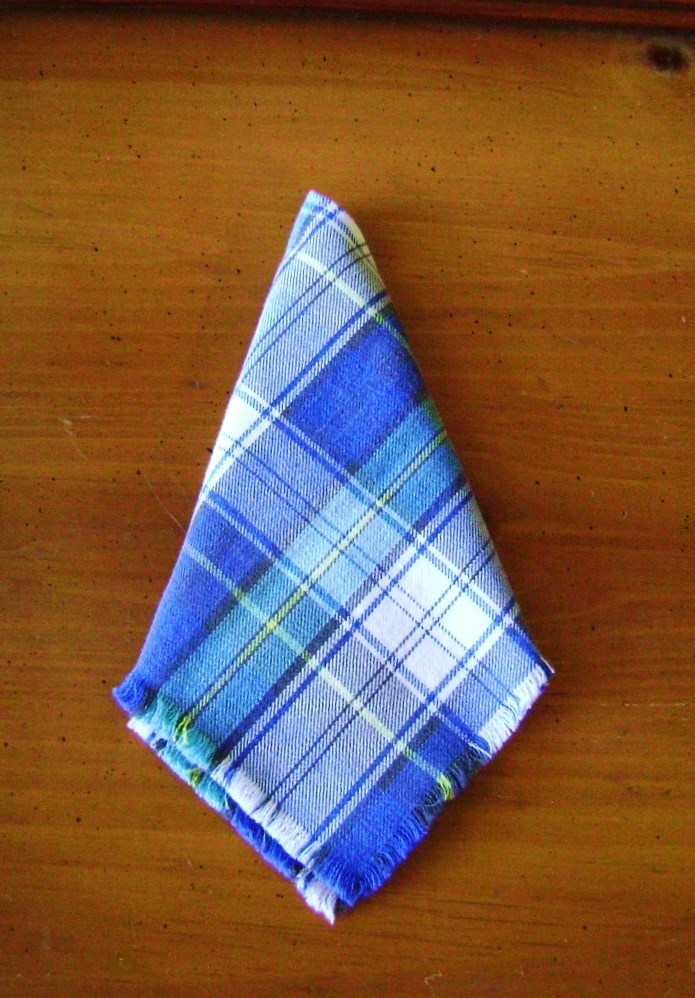
Fringe Benefits: Free Napkins From Shirts
You can recycle your worn-out flannel shirts to make excellent cloth napkins. They're comfy, absorbent, and free! Here's how to do it.
1. Cut napkin-sized squares from the front and back panels of the shirt. 12" square is what I use, in order to get 4 napkins from one shirt. This makes a smallish napkin (cocktail-sized), but it still works fine for daily meals. If you want them bigger, like 16" square, you'll probably only get one or two from the back panel of a shirt.
2. Once you've cut your squares, fringe the edges. To do this, pull parallel threads off an edge until there's about 1/4" to 1/2" of fringe created by the loose ends of the threads going the other direction.
These napkins wash like a dream. Sometimes an extra thread or two will try to liberate itself from an edge after washing. In that case, just peel it off and throw it away (or compost it if it's a natural fiber).
Sunday, October 27, 2013
Book: Solviva
Solviva: How to Grow $500,000 on One Acre, and Peace on Earth
by Anna Edey
This is a marvelous book by a woman who has developed Earth-friendly ways of growing food, running a household, and making a living. She built a home and a big greenhouse on her land in New England, which are solar-heated and have an ingenious wastewater filtering process. After growing vegetables like gang-busters in her south-facing solarium that opens into her home, she built herself an amazing greenhouse and turned it into a salad-production business. If you are interested in saving the Earth, this is the book for you!
Thursday, August 8, 2013
I Love Tasha Tudor
Ever since I was a little girl, I have known about Tasha Tudor. Back then, I knew her as a beloved children's book illustrator and author. When my daughter was born, I carried on the tradition my mother started, by reading her wonderful books to my child. But wait, there's more!
This incredible woman has also become famous for her lifestyle. Up until her death in 2008, she lived a beautiful life, set in rural Vermont--in a house hand-built by her son, and following her favorite 19th-century homesteading practices. She was an avid gardener, cook, spinner, weaver, knitter, candle-maker, and more, in addition to producing her charming artwork.
You can learn all about her in these gorgeous books:
The Private World of Tasha Tudor
by Tasha Tudor, Richard Brown
(photo above)
Tasha Tudor's Heirloom Crafts
by Tovah Martin, Richard Brown
Tasha Tudor's Garden
by Tovah Martin, Richard Brown
Forever Christmas
by Harry Davis, Tasha Tudor illus.
Friday, February 15, 2013
Absinthia Returns, Part 14
This is part of a continuing series of email letters exchanged with my Swedish friend, Absinthia. To see the whole series, start with Living a Simple Life.
Who Needs Money, Anyway?
I'll admit, I have often thought that if only I had enough money for a rainwater system or a solar panel, etc., I could live a simpler life. Well, Absinthia has news for those of us who think that!
Hello,
It
makes me a bit sad when people say they need more time and money in order to
live a simple life, when it is quite the contrary. My husband and I started out on this
journey because we needed to live on less money, not more. So “no money” is
absolutely not an issue. Not at all. All you need is creativity, imagination,
and the will to walk this path. If you have someone to hold your hand when you
take the leap, it will make things much more fun, of course.
One
of the reasons I agreed to do this series with you was my wish to kill the myth
that you need to be rich to live a simple life. Let’s remember the people that
lived like this before us, our foremothers and forefathers. They lived like
this because they couldn´t afford any other way. If they had had any money, I am
rather sure they would have made a few changes here and there ;-).
I
have found that imagination is the mother of invention in many ways. If you
have money, you stop seeing the possibilities, I think. Your mind becomes a bit
lazy. Instead of finding out how to make a dish brush, you throw some money at
the problem. Instead of finding
out how to build your own solar panels, you throw money at it.
As
I mentioned in an earlier letter, I recommend The Complete book of
Self-Sufficiency
by John Seymour. It’s a wonderful book with hands on instructions on how to do
all you need to live what he calls “the good life.” You can find it in most
libraries.
I
am not trying to be rude, or anything like that. I am just saying, you don’t
need money to live simply. You need to stop thinking you need money, you need
to see beyond money. Money is not the start and finish of all… money is just
one tool among millions of tools. That is all it is, no more than that. I
promise! :-D
-
Absinthia
This is the end of "Absinthia Returns." In future posts, Absinthia and I will discuss ways to eat simply.
Labels:
Absinthia,
activisim,
lifestyle,
money-saving tips,
simple life
Sunday, February 10, 2013
Absinthia Returns, Part 13
This is part of a continuing series of email letters exchanged with my Swedish friend, Absinthia. To see the whole series, start with Living a Simple Life.
TV--Putting Life on "Pause"
We have arrived at Part 13 of this conversation with Absinthia... a fitting number for discussing television. 'Nuff said.
Hello,
I
have thought a lot about what on earth might be the reason so many people go on
saying “I don't have time to live simply,” and today I think I've got it! I think
it is television. It passifies you. You sit there, and you receive other
people's thoughts, other people's ideas, other people's activities. You can't change anything. Nothing is in person, and no one accomplishes anything without
throwing money at it.
The
first thing we did when we started our path to a simpler life was we got rid of
the tv. It cost money to have it and we didn't need it for our physical
survival in any way, so “out with it.” And the first two days or so it felt
strange, but after that it felt liberating. So much time to do fun stuff instead of stagnating in front of
the “dumb-box.” Nowadays we get our news from the newspapers on the Internet.
I
no longer get what the charm is with sitting there and staring at a screen with
people running around saying embarrassing things. I don't get the charm in
sitting there hour after hour watching others doing things, when you can DO
things yourself, for real. My husband and I have talked about this more than
once, and we have come to the conclusion that tv actually is more than just a
very passive activity, it has to be a kind of drug.
After
9 years without tv, we just don't get it anymore. Why on earth should we want
to sit on a sofa and stare at a screen showing people doing things?! Why can´t
we sit at the kitchen table and drink tea, instead, where the seats are
comfier, the light is nicer and the background sounds are more discreet? Or
maybe go out for a walk and enjoy the weather and nature!
-
Absinthia
Dear
Absinthia,
I
think you are exactly right when you say it’s a drug. A major reason why so
many people drink a lot of alcohol or take drugs is so they can stop
thinking--about life and things that are bothering them. TV works the same way.
It is hypnotic and mind-numbing.
-
amanda
Hello,
Hmmm,
now you make me think again! ;-)
When
we visit someone, we always end up in their sitting room, on a sofa in front of
the tv for “something to do.” For so many people, tv is seen as
normality, common, and necessary for the survival of civilisation as we know
it--which of course is not the case. Probably quite the opposite, if you think
about it.
I
know there is a silent revolution against this kind of behavior though. More
and more I hear comments like, “Let's sit in the kitchen, it is so much more
relaxed and nice there.“ A small
kitchen revolution has been growing slowly but surely. More and more, people
would rather sit in peace and sip some nice tea. It is a silent and humble
reaction, but a nice and tasty one. ;-)
-
Absinthia
Dear
Absinthia,
I
worry that our culture is being directed by tv, advertisers, media, and
Internet services. I suppose the
best thing is to do what we personally believe in, and let everyone else march
to those ever-present “drums” as they choose.
-amanda
Labels:
Absinthia,
activism,
lifestyle,
money-saving tips,
simple life,
television,
time management,
tv
Friday, February 8, 2013
Absinthia Returns, Part 12
That's my girl!
This is part of a continuing series of email letters exchanged with my Swedish friend, Absinthia. To see the whole series, start with Living a Simple Life.
Second-Hand Crafting: Nappies!
When my kids were babies, people thought I was nuts to use cloth diapers. But even then, I didn't know about hand-knit wool soakers. I went through all kinds of gyrations to find snap-front nylon diaper covers, to allow some airflow for my little ones. I am so pleased that cloth diapers and wool soakers have become popular. The simple life is winning!
Hello,
I
also make nappies (diapers) and soakers (diaper covers) from second-hand cloth
and wool yarn.
Baby
Nappies
Cloth
nappies are best made of cotton or linen--soft and easy to wash. I find that
bottom sheets, curtains, or dish-drying cloths are the best choice for this.
Duvet covers are often a bit too thin for this. If you can find cute patterned
curtains, or solid colored of course, you can make lovely nappies very easily.
You just make them like cloth napkins, but a bit bigger. Easy!
My
mother says a very soft cotton is the best kind of fabric to use--a “thirsty
cotton, with a lot of sucking in it.” Yeah, it sounds strange I guess, but it
makes a lot of sense when you say it in Swedish. I guess you know of a better
way to say it in English? Absorbent? It doesn´t have to be terry cloth or some other extra soft
cloth. Ordinary dish-drying towels can work just fine, as long as they are big
enough, and you wash them in the hottest cycle on your washing
machine.
I
make them from an old pattern my granny taught me. I make them like big, hemmed
squares: 50 x 50 cm for newborns, 60 x 60 cm for medium-size, and 80 x 80 cm
for older babies.
When
you use your nappies, you fold them many times, like an accordion. First you
fold the square into a triangle, and then you make an accordion in the
middle. When you put the nappy on
the child you put it in place between the baby's legs. Then you start pulling
up the soaker, while at the same time folding the nappy out a bit in front and
in back, to tuck it in place more comfortably inside the soaker. Easy :-)
Here’s a link to a Swedish website with pictures showing how to fold and put on a
homemade nappy.
Don’t
wait too long to change the nappy. Change as soon as possible, rinse in cold
water. Wash on the warmest cycle. Air-dry, don´t tumble dry. It wears the
textile down very fast.
Don´t
use regular bleach. It is very
hard on the fabric. Do a “fresh bleach”
now and then, where you soak in fresh lemon juice and then air-dry outside so
they get bleached by the sunlight.
Never
wash them with fabric softener. It kills the absorption rate completely! If you want the nappies softer, add
some vinegar in the rinsing cycle. Just a spoon, or it might be damaging to
your machine. Another way to
soften them is to wad up the nappies after drying, pull gently from the
corners, and then fold them. This makes the cloth less stiff and it straightens
out the nappies so they keep their square shape, which makes the folding so
much easier when you fold it in place on the baby.
If
you do these things, your nappies can last for ages and ages. Very low cost,
both monetary and climate wise. :-D
Absinthia's homemade nappies
Soakers
For
soakers, pure wool is the very best (not superwash!). I knit all soakers in “fat wool yarn,” meaning wool that has
not been washed before being spun into yarn. Fat wool yarn is soft, very soft,
and the lanolin works like a lotion for the baby’s sensitive skin.
When
you change a nappy, change the soaker as well and let the soaker air-dry until
the next change. It is enough to wash the soakers and re-soak them in lanolin
about once every 4th-6th week actually. With a pack of approximately 20 cloth
diapers and 4 soakers in every size, you and baby will be just fine :-D
Caring for Your Soakers
Between
changes, air-drying works great for soakers as long as they are 100% pure wool.
Not superwash, not wool blend, just pure wool. After the air-drying, preferably
outside, just sniff it a little to make sure it's okay to re-use. After a while
it will no longer smell fresh. Then you need to wash it and re-soak it in
lanolin. As long as the wool is full of lanolin it will not absorb the stuff in
the diaper. ;-) That is why this very simple method actually works. That is
also why it is so important to make sure you soak your soakers in lanolin
before you start using them for the first time.
Here
you can buy lanolin (wool fat) at the apothecary. It is easy to re-lanolin
soakers. Just pour a good dollop on them and squeeze back and forth until the
lanolin has spread all through, then air-dry them again.
The
soakers might leak a little at the beginning. They have to felt a little before
they get completely “air-tight.” If you want to prevent that, wash them once or
twice and re-lanolin them very thoroughly before the first real usage.
To
take the best care of your handmade soakers, wash them with shampoo in lukewarm
water only. Like nappies, never
wash them with fabric softener.
I
think that is all my recycling tips right now. It is time for some tea.
Labels:
Absinthia,
babies,
baby,
diaper covers,
diapers,
lanolin,
laundry,
lifestyle,
money-saving tips,
nappies,
simple life,
soakers
Tuesday, February 5, 2013
Absinthia Returns, Part 11
Bed from the Early Modern period of German furniture (1500-1800)
photo by R. Engelhardt
This is part of a continuing series of email letters exchanged with my Swedish friend, Absinthia. To see the whole series, start with Living a Simple Life.
Second-Hand Crafting: Bed Linens
Hello
again,
In
Sweden, we would probably die without duvets. Seriously! Sometimes we have
duvets and blankets on top of that! We have thin duvets for spring and autumn,
and thick duvets for the midwinter.
During midsummer, we don’t need duvets at all.
Here
are some second-hand sewing projects for the bedroom.
Bed
Sheets
Two
small sheets can be made into one big sheet. The seam will be positioned across
the bed at approximately knee height, so it is hardly noticeable.
Duvet
Cover
Here’s
how I make the Swedish version of duvet covers from two fitted bottom bed
sheets. Measure a well-fitting
duvet cover. Use that as a model when cutting off the sides of the bottom
sheets. With right sides together, sew the two bottom sheets together, leaving
two corners at one end open enough to be able to get your hand in. Hem the edges of the open corners. At the other end, sew the two corners shut, and leave the short side
partially open so you can stuff the duvet in later. This end will go at the foot of the bed. Turn the duvet cover right-side
out. Embroider if you feel like it. If you don´t embroider, it will all be done
in about ten minutes.
To
insert the duvet, you push it in through the lower partial opening. Then you
put one hand through one of the upper corner-holes, the other hand in the other
corner-hole, grab an upper corner of the duvet with one hand, the other corner
with the other hand, and then shake gently until the duvet is in place inside
the duvet cover. Some people like to sew a button and a button hole so you are
able to close the lower opening. I have not yet tried it, but it seems
practical.
Pillowcases
Measure
a pillowcase that fits well, and use that as a model. Fold the fabric you want
to use so it’s doubled. Cut it according to your measuring plus a quarter of an
inch to make space for hems and seams. Sew the two short sides plus one long
side. Leave the other long side open (to be placed uppermost when using). Hem
it. Sew nice ribbons in place so you can tie the pillowcase shut later. Turn it
right-side out. This is a very classic style here in Sweden. All of my grandmother’s
old pillowcases looked like this. If I feel ambitious, I can add decorations
like lace ribbons sewn along the sides or some sweet embroidery.
Traditionally
we add some small embroidery diagonally at one of the upper corners, the
initials maybe or some cute motif, not necessarily fancy. Just something to
brighten things up a bit. Everyday life needs a bit of a golden rim too, you
know ;-)
-Absinthia
Dear Absinthia,
My philosophy is, "use the beautiful, old things
passed down from family... or give them to someone who will." My friend, Alice, has sold quite a few
vintage and antique linens for me, to ladies who are thrilled to get them.
Labels:
Absinthia,
bed,
bed linens,
duvet,
lifestyle,
money-saving tips,
pillowcase,
second-hand,
sewing,
sheets,
shopping,
simple life,
used
Saturday, February 2, 2013
Absinthia Returns, Part 10
This is part of a continuing series of email letters exchanged with my Swedish friend, Absinthia. To see the whole series, start with Living a Simple Life.
Second-Hand Crafting: Fabrics, Yarn
The practice of recyling and re-using is something my mother and the women in her family were very good at. Since then, our culture has done a flip-flop on that, and I'm happy to see that Absinthia is leading the way back to this important way of life!
Hello,
When
I go shopping, I go to second-hand stores. Mostly I look for curtains and bed
linens in natural materials like cotton, linen, hemp, and wool. I never care
what color it is. I can dye it easily if I don´t like it, as long as it is in a
natural material. I mostly look for solid colored items, but sometimes I find a
nicely patterned cloth too.
When
I get home I wash everything as hot as possible, depending upon what kind of
material it is. When that is done, I dye it if necessary. And then I make it
into whatever I want to make it into.
If
I find something knitted or crocheted, I buy it if the yarn is a natural fiber
and in good condition. At home I frog the yarn, wash it, and let it air dry
hanging with a bit of weight to make it straight again. If needed, I dye it
too.
Curtains
Bed
sheets can be made into curtains with very little sewing. I make a small ordinary hem at the
bottom. Then at the top, I make a
wide hem, wide enough to fit over the curtain rod. Then I either crochet a nice
curtain tie-back, or if I have enough left over from the sheet, I sew a curtain
tie-back. Very easy.
Table
Napkins
Second-hand
curtains and bed sheets can be made into napkins, as long as the fabric is
cotton or linen. Hemp is too
scratchy. Just measure up what you think is the ideal size for a napkin with
extra allowed for the hems. Fold the cloth into a bunch of this size, cut up,
and then hem the edges. VoÃla, you have a family pack of matching napkins, for
almost no cost at all! :-)
-Absinthia
Dear Absinthia,
My good friend, Alice, owns a resale shop. She told me that often when a customer
is interested in an item but hesitating to buy, she says to them:
“I don't want you to buy this if you're not going to use it
or display it. Will it end up in a
closet? The garage? There are other people waiting to find
it and love it.”
Now that's the kind of shopkeeper who helps us stay on
track!!
-amanda
Labels:
Absinthia,
curtains,
lifestyle,
money-saving tips,
napkins,
re-use,
recycle,
recycled fabric,
recycled yarn,
recycling,
resale,
second-hand,
sewing,
simple life,
thrift,
used
Friday, February 1, 2013
Absinthia Returns, Part 9
Tudor-style bathroom in Leeds Castle, Kent, UK photo by Sigismund von Dobschütz
This is part of a continuing series of email letters exchanged with my Swedish friend, Absinthia. To see the whole series, start with Living a Simple Life.
Things to Make at Home: Bathroom, Pets, Misc.
Here's the final portion of Absinthia's list of things she makes at home to save money and live more simply.
Hello,
Pattern
collections from online yarn companies can be very inpirational for me. I often
look through Pierrot-Gosyo’s patterns to see their take on things. I look for
easy solutions, very “clean” style and design. I look at the pictures and go
“yeah, that’s a nice idea,” and then I start making my take on things,
according to our needs at home and the materials we have here.
Like
curtains in front of bookshelves. Super smart! Makes the room less “chaotic”
with nice solid-colored curtains, and it protects from dust so the weekly
cleaning goes much faster now.
There
are some other make-it-yourself ideas out there, like ladies pads and family
cloths, which I will let you discover for yourself. ;-)
Here are
my money-saving ideas for the rest of the house:
Bathroom
-
scrubbies: crochet
-
soaptray: crochet with plarn
-
rugs: crochet
-
towels: sewn and some knitted
-
curtains: crochet
-
hanging flower pots: made from empty buckets and crochet
-
deodorant: baking soda and coconut oil
Pet
Items
-
dog toys: made with empty small cartons, rags, simple crocheted amigurumis
-
sweaters for dog: knit and crochet
-
wipes for dog: sewn
Miscellaneous
-
bookmarks
-
dolls and doll clothes
-
Christmas decorations
-
shoe-shapers: stuffed shoe-forms, which help shoes to dry and keep their shape
(crochet and sewn)
-
Absinthia
Bathroom in the Central Hotel, New Haven, MO photo by Joanna Poe
Labels:
Absinthia,
bathroom,
lifestyle,
money-saving tips,
pets,
simple life
Thursday, January 24, 2013
Absinthia Returns, Part 8
19th-century cabin in Indiana
This is part of a continuing series of email letters exchanged with my Swedish friend, Absinthia. To see the whole series, start with Living a Simple Life.
Things to Make at Home: Bedroom, Living Room
Here's what Absinthia makes for her own living room and bedroom areas and the book she loves for self-sufficient living.
Hello :-)
I really
recommend The Complete Book of Self-Sufficiency by John Seymour. He wrote
a wonderful book with hands-on instructions on how to build your own stove and
how to heat water with a home made solar panel system--in short, all you need
to live what he calls “the good life.” You can find it in most libraries! :-D
(Note from Amanda: if you are a vegetarian, be forewarned that there are sections on meat preparation. When I can get my own copy of the book, I'm considering taking those pages out, or re-binding the whole thing in a loose leaf notebook, with those pages left out or tucked in an envelope. Don't want to even think about those topics.)
Here are
my make-it-yourself money-saving ways in two more rooms of the house:
Bedroom
-
handkerchiefs: sewn
-
blankets: crochet and knit
-
rugs: woven and crochet
-
curtains: sewn and crochet
-
laundry baskets: crochet with tarn
-
baskets: crochet
-
bags: crochet
-
slippers: crochet and knit
-
doilies: crochet
-
pictures: embroidery, painted
Living
Room
-
rugs: woven and crochet
-
blankets: knit and crochet
-
pillows: mostly crochet, but some sewn
-
seat covers for sofa and chairs: crochet
-
doilys and runners: crochet
-
curtains: sewn
-
flower pots: made from buckets for which I crochet fitted holders--nice for
hanging baskets, too. :-)
-
Absinthia
The conversation is continued here:
19th-century cabin in Tennessee, photo by Thomas R. Machnitzki
Labels:
Absinthia,
bedroom,
lifestyle,
living room,
money-saving tips,
self-sufficiency,
simple life
Tuesday, January 22, 2013
Absinthia Returns, Part 7
18th-century-style Swedish kitchen
This is part of a continuing series of email letters exchanged with my Swedish friend, Absinthia. To see the whole series, start with Living a Simple Life.
Things to Make at Home: Kitchen Items
Here's what Absinthia has to say about saving money in the kitchen.
Hello
again!
Time
is the only thing we have, always. Money comes and goes, sun and rain also, but
time is always there, right by your side.
Here’s
how we save money in the kitchen by making things ourselves, re-using, etc.
I
save whatever cartons and buckets that come when buying things like food. They
are handy when freezing, and to use as pots for plants.
-
margarine: I make my own margarine by whipping butter and rapeseed oil
together.
-
birdfood: made from leftover bread crumbs and fat from cooking
-
sourdough bread: I feed the sourdough with leftover stale bread, noodles, rice
etc.
-
freezer containers: cartons and
buckets that come when buying foods
-
dish-scrubbies (also called tawashis): crochet, plarn (yarn made from plastic
bags)
-
dishbrush: tie spring birchtwigs together according to old local traditions
-
dishrags: knit and crochet cotton, linen, or hemp
-
towels: knit cotton, linen, or hemp.
I knit them in some nice stitch, like “feather and fan” or moss stitch.
-
soaptrays: crochet using plarn
-
placemats and coasters: crochet
cotton, linen, hemp, or spun tarn
-
napkins: sewn
-
tablerunners/doilies, etc.: crochet
-
cup cozies and jar cozies: crochet cotton, linen, or hemp
-
flower pot covers: crochet cotton, linen, hemp, or spun tarn. I make them to go
over small plastic buckets, tin cans and jars.
-
curtains: crochet
-
baskets: crochet
-
seat covers for kitchen sofa and chairs: crochet
-
stool covers: we save every little inch of yarn leftovers, spin it together,
and use it to make colorful stoolcovers, chair pads etc.
-
chair leg covers (saves the floor from ugly marks): crochet cotton or linen
-
mats and rugs: woven and crochet tarn or spun tarn
-
hotpads: crochet wool
-
potholders and oven mitts: crochet wool
-
dusters, crochet acrylic. I can
make them static so they “suck up the dust.” :-)
-
seat covers and back covers for kitchen chairs: crochet tarn. Very cute
actually ;-)
More
to come: living room and bedroom.
-
Absinthia
Labels:
Absinthia,
kitchen,
lifestyle,
money-saving tips,
simple life,
time
Subscribe to:
Posts (Atom)